
Canyon Street – the commercial heart of Creston – has undergone a remarkable transformation since the fledging town was established over a century ago. Join us for a self-guided walking tour of downtown Creston, and we’ll show you how and why that transformation took place.
Start at the Visitor Information Centre at 121 Northwest Boulevard, then click on each of the photos below to follow our six-block route.
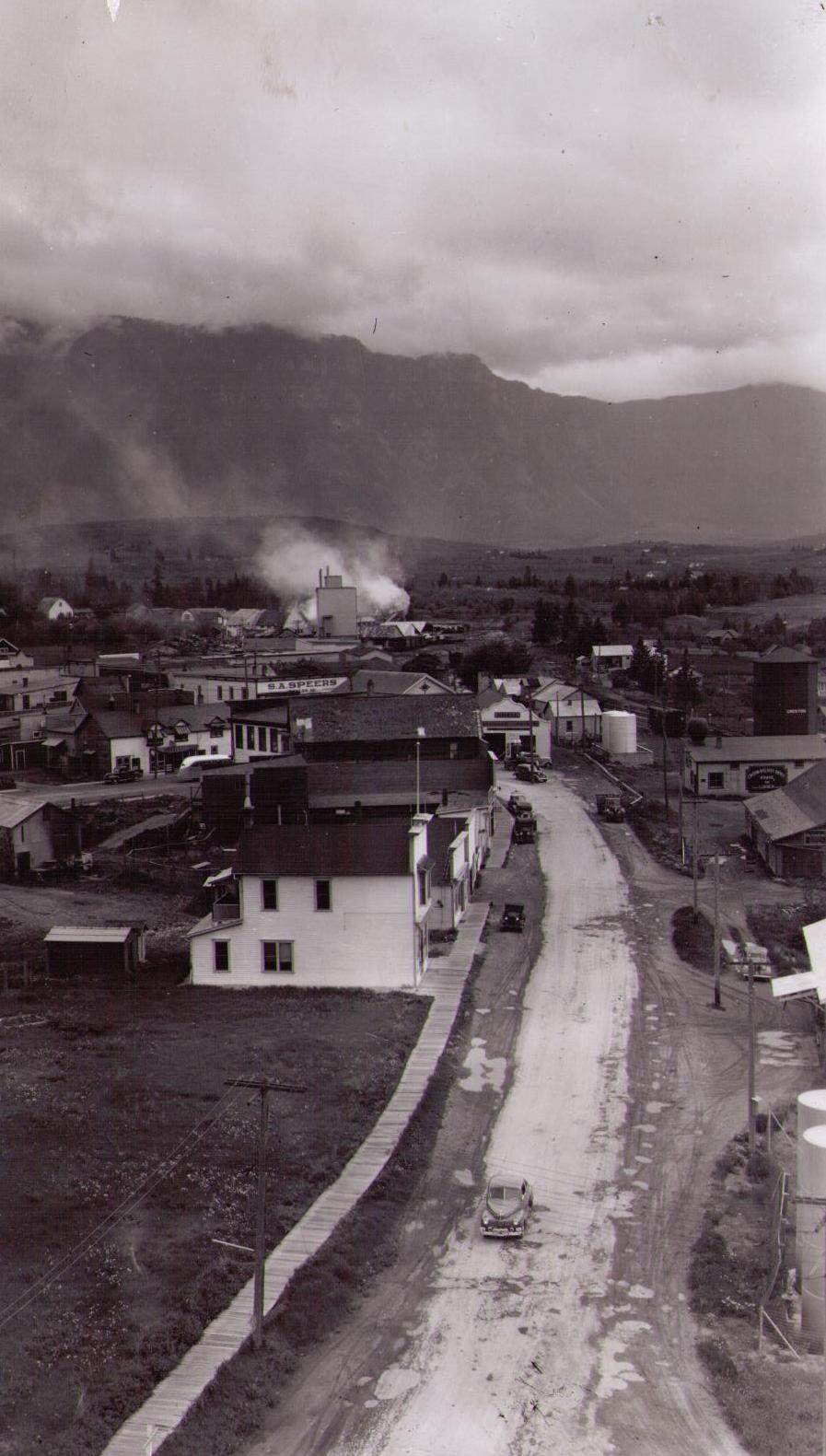
View from the Grain Elevators, 1947The modern community is beginning to emerge from the settler town. Agricultural land surrounds the downtown core, but modern industry dominates. The water tower of the CPR station, at centre right, hearkening back to the steam-train era, sits alongside the vertical white tanks of two bulk fuel plants. Narrow, dirt streets are just one step removed from the horse-and-wagon days - but massive change to the street and the buildings is just a few weeks away. Join us for a walking tour of downtown Creston and we'll show you how this transformation came about. Start by exiting the back door of the Visitor Information Centre and walking through the parking area until you reach a path and set of stairs leading down the hill on your right.

Fourth Street, 1910-1913Standing at the top of the stairs behind the Visitor information Centre gives us a glimpse of the original commercial district. It began at the bottom of the hill, in response to the anticipated construction of the Great Northern Railway. But the Canadian Pacific Railway was the first to actually arrive - and it built its line at the top of the hill. So all those early businesses quickly relocated, creating the scene in this photo.
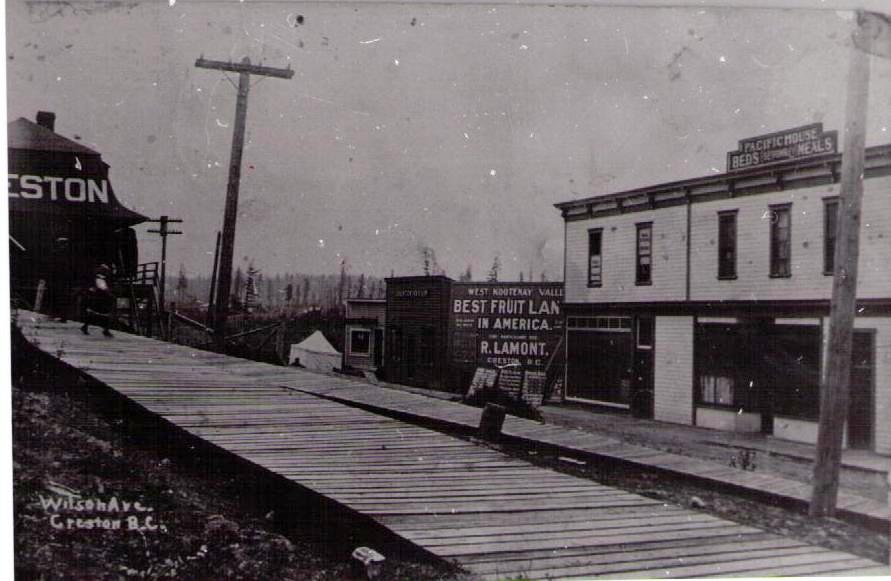
Wilson Avenue, Creston BC, c. 1908Wilson Avenue, seen in this photo, stretches away to your left as you stand at the top of the stairs enjoying the view of Fourth Street. The little building at the far end of the row is the Creston Review newspaper office, and next to it is the tent of a Chinese laundryman. Across the street and directly alongside the tracks is the CPR station, and you'll notice that it faces away from the commercial district down the hill. This presented a fairly significant marketing challenge...
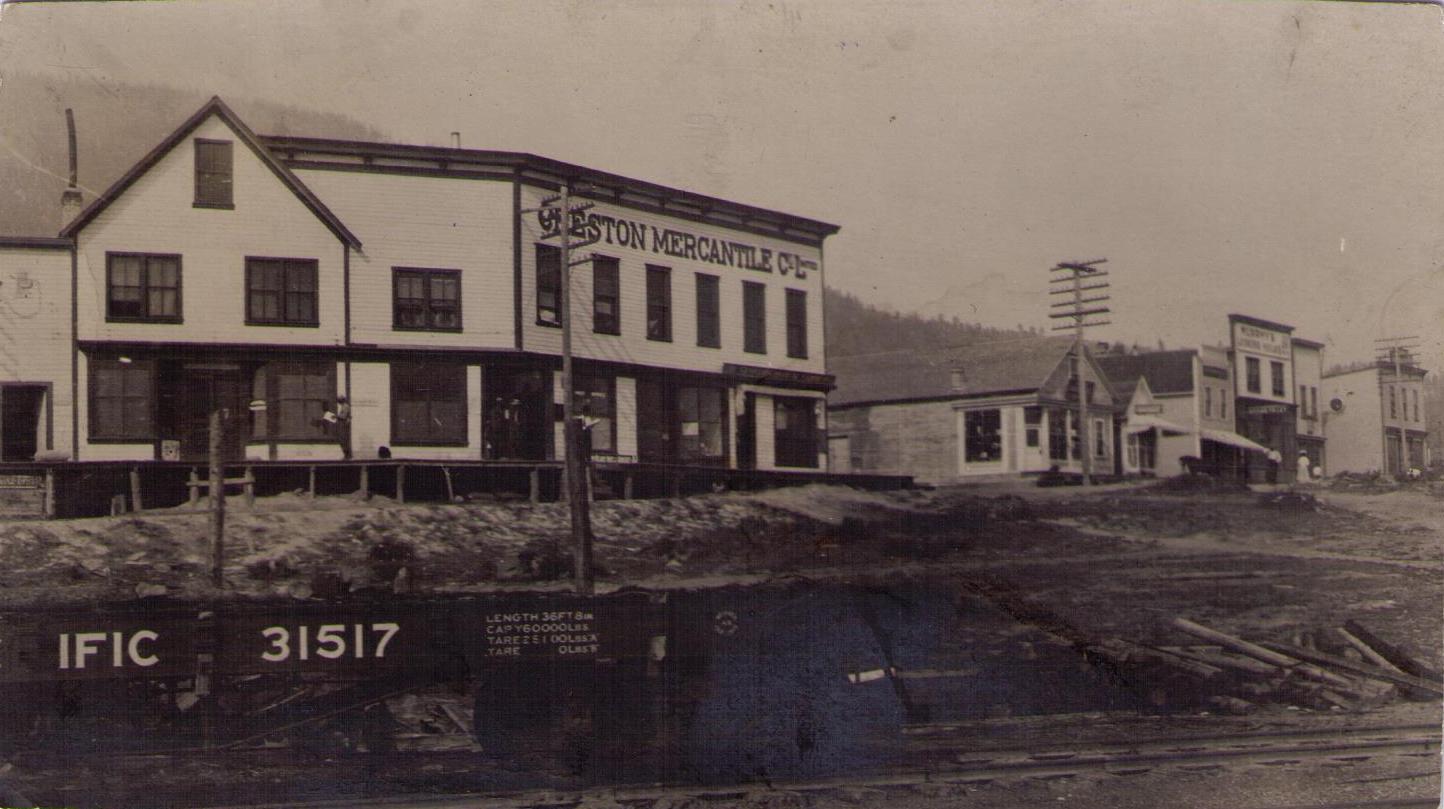
Mercantile Store, Creston BC, 1908...so, if you turn around and climb the stairs on the opposite side of the parking area, you'll see the solution. Businesses very quickly started moving up to what is now the main street. The giant Mercantile, a general store, was one of the first, with real estate offices, banks, and other stores stretching away on either side. This photo shows the Mercantile on the corner where the bakery is now, then the Crawford Block, home to the telephone exhange, where the Royal Bank now stands. Beyond it is a small furniture store, then Pat Burns Butcher Shop (still standing); Murphy's Boarding House; a jewel;ers and watch-makers; and Scott's Boarding House (now the Creston Valley Advance office). The two boarding houses here, plus no less than three hotels in the Fourth Street photo, clearly reflect Creston's transient population at the time.
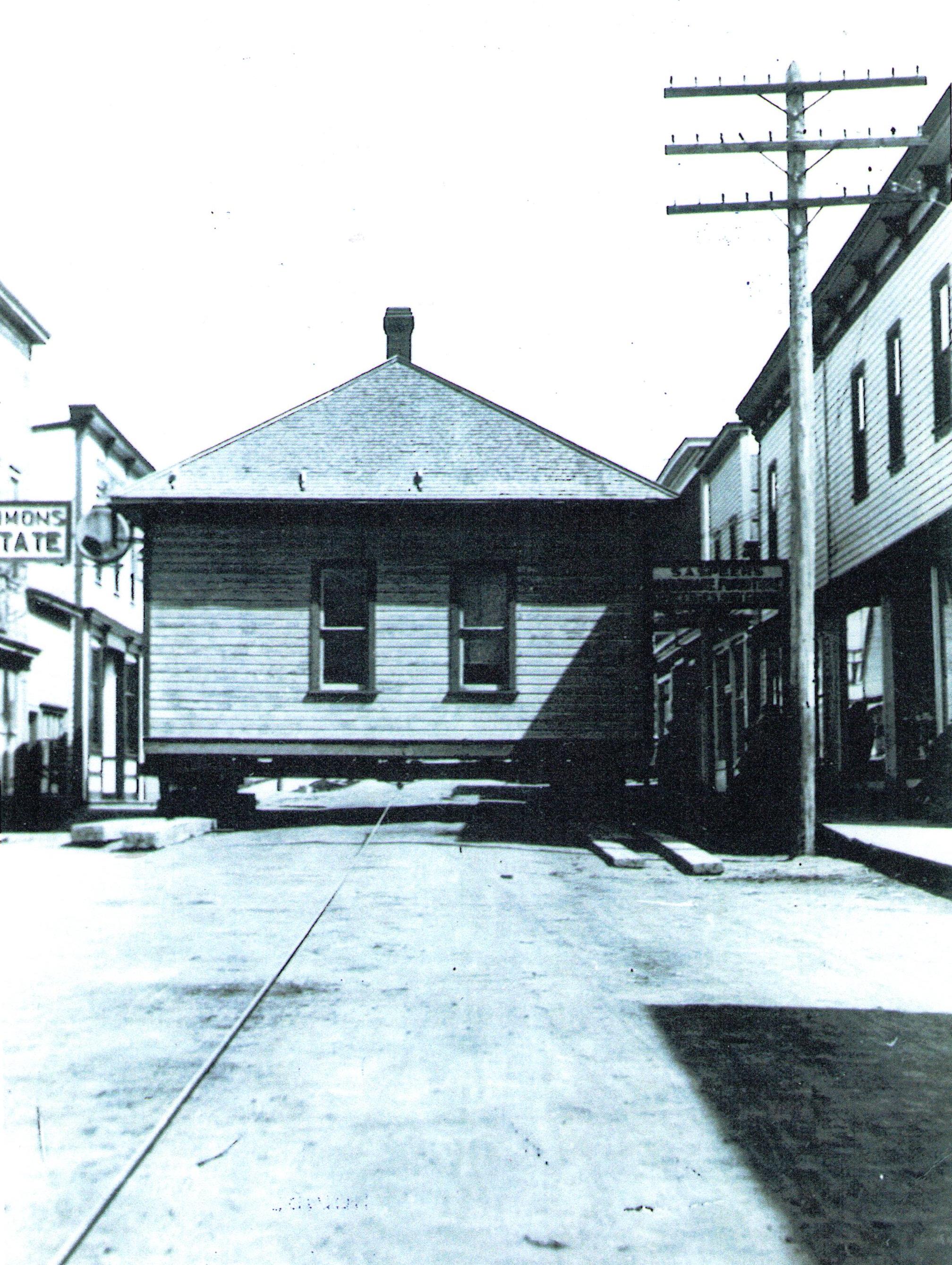
Sinclair-Smith House, Canyon Street, Creston BC, 1926Like today, the favoured building spots for homes and farms were close to shopping and transportation, but sites that were just a little way out of the prime commercial district were a little less expensive. So we see residential neighbourhoods being built up along Pine Street, up 10th Avenue North, and east onto Canyon Street. As a result, what we now consider “downtown” was once an eclectic mix of commercial and residential buildings. As the commercial district moved steadily eastward, property owners realised their land was far more valuable as commercial lots than farms. In 1926, Robert Sinclair-Smith jacked up his house, skidded it down the street to a new lot near the Anglican Church, and built two store buildings on his lot on the south side of Canyon Street. One of them bears his initials to this day.

VE Day, Canyon Street, Creston BC 1945Cross the street and walk east one block to the corner of Canyon Street and 11th Avenue North to appreciate this view of Canyon Street, decorated for the VE Day parade in May 1945 (that's Hitler hung in effigy from the roof of what is now 'Lectric Avenue). The street is about twenty fee twider now, but many of the buildings still stand. It looks like a sold wall of buildings, but if you look closely, you'll notice there are gaps in between many of them - a clear sign of the rather piecemeal evolution of Creston's commercial district.

Canyon Street, Creston BC, 1947From where you stand on Canyon Street and 11th Avenue, look east. You're standing right underneath the canopy of the Grand Theatre, visible on the left side of this photo. Across the street is the medical clinic of Dr. henderson and Dr. Murray, a tall brick drugstore, and, far beyond that, the Tivoli Theatre (still standing). You'll notice very different building materials - stone and brick, rather than wood - and different architectural styles compared to those of the previous block. This section of downtown Creston reflects the post-war building boom that saw the commercial district's relentless, eastward march accelerate...

East of Downtown, Creston BC, 1915...consuming hundreds of acres of former farmland as it went. In this photo, taken baout 1915, Canyon Street is merely a narrow dirt track almost hidden between the orchards and disappearing up the hill through the forest near centre-right. Dr. henderson's house, located behind the clinic visible in the previous photo, stands near the centre; the dark, square, two-story house to the right of it has now been replaced by a gas station on the corner of Canyon Street and 16th Avenue. The large open field in the background is Dave Learmonth's dairy farm and alfalfa hay field - and the present site of the Rec Centre.

Universal Motors, Creston BC, 1947Walk up to the next corner, 12th Avenue North, and cross the street to stand in front of the CIBC. Looking back the way you've just come gives you a really good sense of how much the commercial district has changed since this photo was taken in 1947. A clue to a major reason for this can be seen on the left edge of this photo: Universal Motors, now the Downtowner Motor Inn, was one of at least five car dealerships and service stations in Creston in the 1950s and 1960s. Increased mobility, increased prosperity, increased availablility of consumer goods: all of this added up to a rapidly expanding commercial district.

Premier Garage Fire, Canyon Street, Creston BC, 1938Return back along Canyon Street towards 11th Avenue North. Stop about halfway down the block, opposite the pet store. That's the scene, more or less, of another major cause of change to the commercial district: fire. legend has it that a devastating fire destroyed all the businesses on that side of the street except the Grand Theatre. That is true...but all three businesses on that side of the street were in a single building: the Premier Garage, which burned to the ground in 1938 and badly scorched the Theatre as it went.

Widening Canyon Street, Creston, BC, 1947You can almost replicate this scene by continuing back along Canyon Street to about Panago and looking across to Morris Flowers, which now occupies the Impoerial Groceteria building seen in this photo. One of Canyon Street's most transformative influences was its designation, in 1947, as part of the BC Southern Provincial Highway. The highway required a minimum width all along its length - so the buildings on both sides of Canyon Street were jacked up and rolled back ten feet. There were a few exceptions, though...

Canyon Street, Creston BC, 1947Continue west to the corner of 10th Avenue North. This photo shows the newly-widened Canyon Street - with the exception of the Crawford Block, on the corner where the Royal Bank is now. The owners of that building flatly refused to give up ten feet of their property, and so their building stuck out into the street, forming a rather abrupt end to the sidewalk along that side of the street. It took five years of negotiating before the situation was resolved.
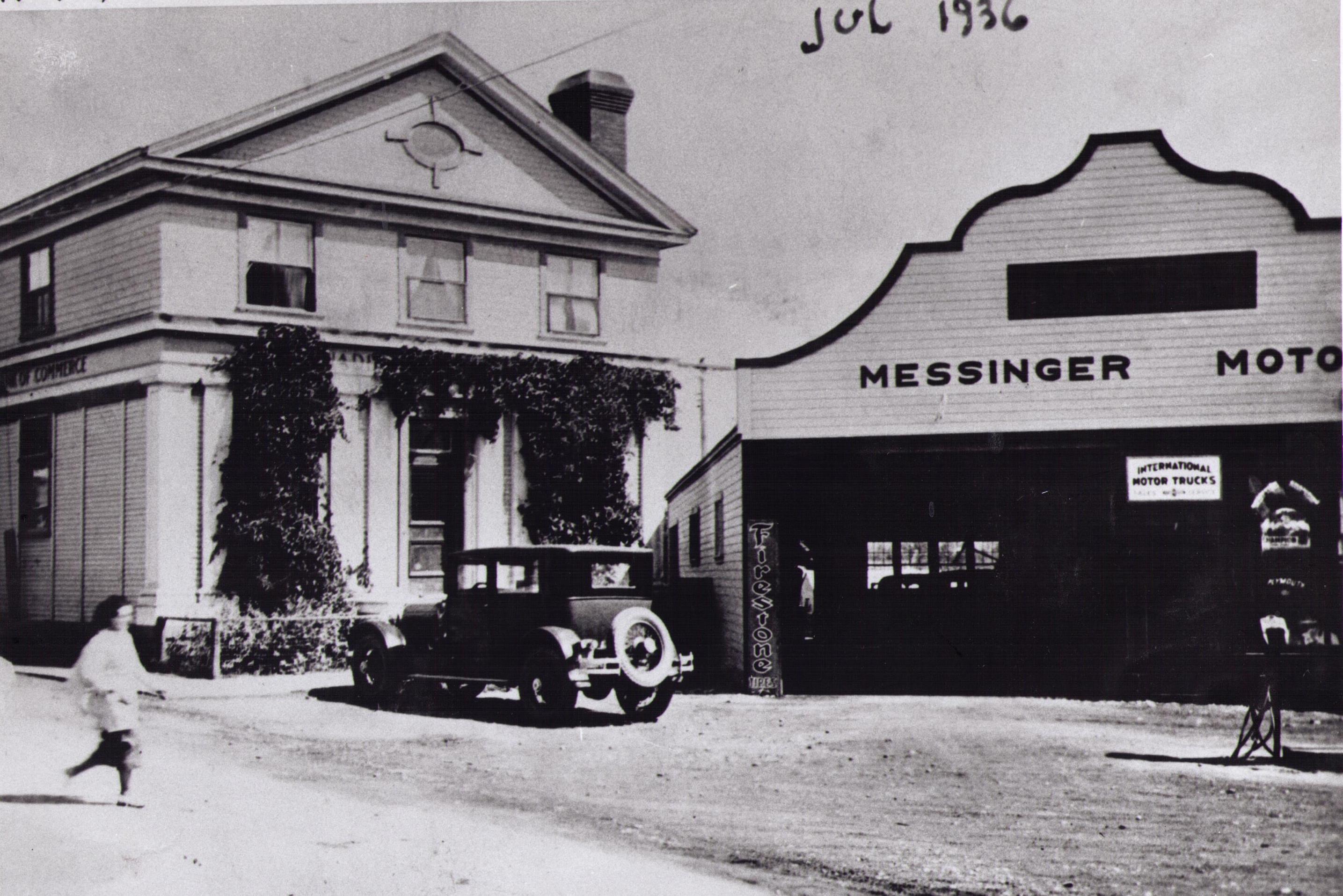
Bank of Commerce, Canyon Street, 1936A second exception to the move-them-back-ten-feet process was the Bank of Commerce, now Jordan's Financial Block, on the corner where you're standing. The bank, built in 1911, featured a concrete fondation - part of the bank's efforts to convey solidity and stability in a rapidly-changing frontier town. That foundaton meant it couldn't be easily jacked up and rolled back. If you cross to the traffic island and lok back towards the building, you'll see evidence of the innovative solution: The green door on the end of the building facing you is the same door in seen this photograph - but it is no longer centred on the buliding. The workers simply lopped ten feet off the Canyon Street side of the building.
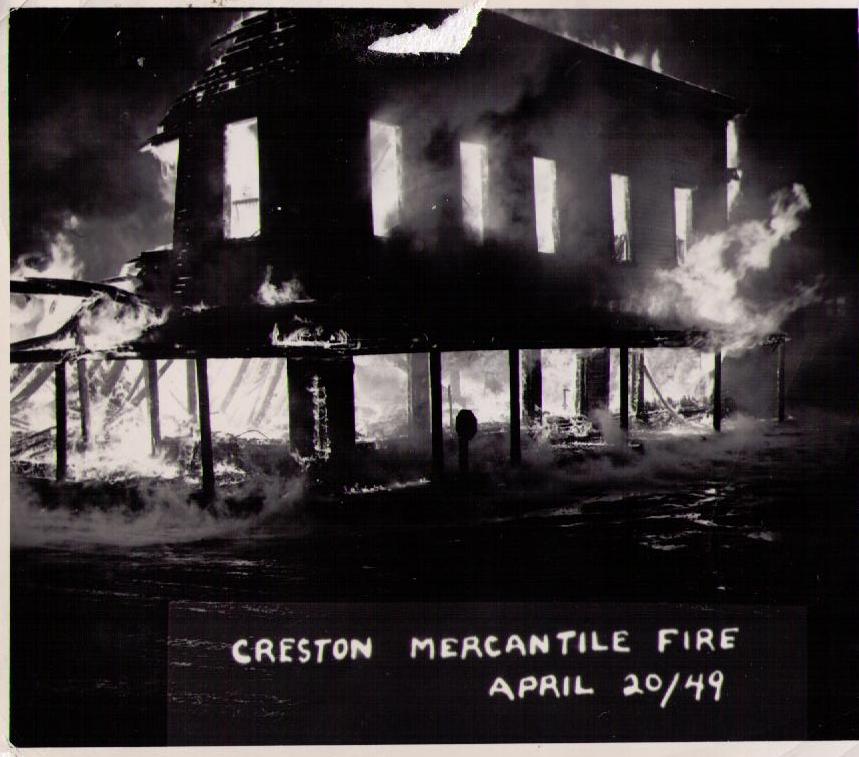
Creston Mercantile Fire, Creston BC, 1949While on the traffic island, turn to your left to face the bakery across the street. Remember the Creston Mercantile - the great big, wood-frame general store we talked about at the start of the tour? It was much too large to move back, so it, too, extended into the street - with the high wooden sidewalk and hitching post in front, almost as far as the turning lane today. This created a considerable bottleneck in traffic on Canyon Street - right up until April 1949, when the Mercantile solved the problem by burning down.

Canyon Street, Creston BC, Looking East, 1954Take one last look east on Canyon Street before you return to the Visitor Information Centre. Today, you'll see the street looking much as it does in this photo taken about 1954 - the end result of nearly five decades of transformation. There have been a number of changes since then, though they are more subtle than the ones in the first half of the century. Compare this photo to hte scene before you. Can you see some of those changes?