

(The Former Life of 1014 Canyon Street)
In earlier articles, we’ve dived into the newspapers in search of the whole story, and we’ve sent you on a scavenger hunt around town to find buildings. For today’s Daily Dose of History, let’s combine both of those: a search through the newspapers for the story of a building.
“The Auditorium (the former Peekin Theatre) has just been completely remodelled and a part of the west half of the building has been fitted up and is occupied by E.G. Timmons as the Electric Shop, in which he is displaying a nice line of electric fixtures. The entrance of the building is used as a pool room.”
I almost missed this little paragraph in the May 23, 1930 Creston Review. It was actually the ad next to it for the Electric Shop that had caught my eye. I photocopied the ad for our upcoming Electrified exhibit, then, as I was putting the copy on my growing pile of information about Creston’s electrical history, I noticed the paragraph about the building – and promptly got side-tracked for the rest of the day
I learned about the Peekin Theatre, Creston’s first movie theatre, twelve years ago when I first started working at the Museum. It was built in 1919, and replaced a year later by its larger successor, the Grand. At the time, I was told that no one knew where it was, except that it was certainly not on the corner of 11th Avenue and Canyon Street. That’s where the Grand was built (now Pharmasave), and since the Peekin continued to operate while that building was going up, they could not have been the same structure.
This isn’t the sort of thing that has kept me awake at nights, but every now and then I’d wonder, “Where was the Peekin Theatre?” Now, by pure chance, I’d stumbled across a reference that related it to two other businesses in town. But where was the Auditorium – or Timmons’ Electric Shop, for that matter?
A newspaper clipping attached to the obituary for Dave Timmons, father of E.G. Timmons, states that the Timmons building was on the same lot later occupied by Greyell’s clothing store. That lot is at 1014 Canyon Street, the present-day site of Mane and Nails Salon and Tony Mulder Jewellery.
The original building on this lot was, over its lifetime, a very busy place.
Frank Bast, in about July 1908, built a two-storey building on Canyon Street that doubled as a rooming house and hall. In October 1909, seven rooms were ready for boarders; by January 1910, fourteen rooms were available. The first reference to the building as “the Auditorium” appeared in November 1909, though the hall was available for dances and other events at least a year earlier than that. Mrs. Murphy established a clothes cleaning, pressing and repairing business in the Bast block in April 1910, and two months later took over – and renamed – the boarding house. At that time, meals were available for 25 cents.
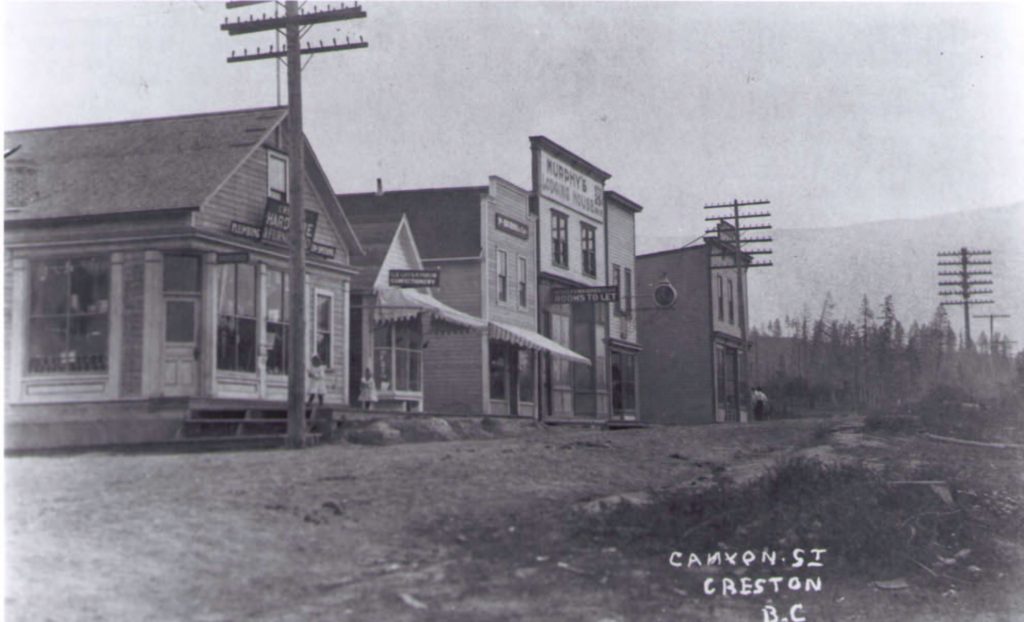
Murphy’s Boarding House is the fourth building from the left.
The hall was on the ground floor of the building, and had “a stage and a real curtain.” The Auditorium hosted a wide variety of concerts, wrestling matches, and other entertainments, as well as meetings of local organisations including, during the First World War, the local chapter of the Patriotic Fund. In 1913, the owners of the Rex Theatre in Cranbrook began showing moving pictures there; in January 1912, the Review announced that there would be “roller skating every afternoon and evening at the Auditorium.” According to one source, at some point it housed a shooting gallery. It was also the venue for Creston’s first official fall fair, held in September 1918.
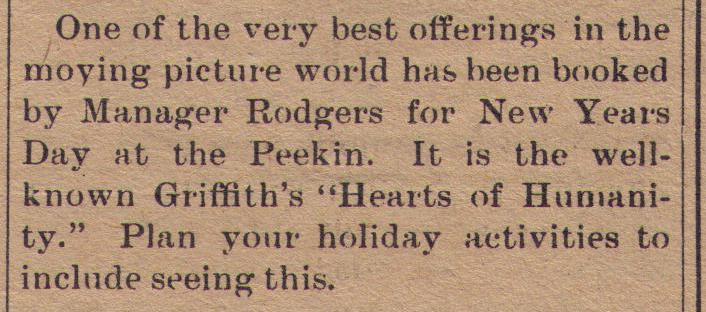
In September 1919, the Peekin Theatre opened. According to the Review, “The old Auditorium has been thoroughly renovated and certainly no expense has been spared in any direction to make the Peekin a thoroughly modern moving picture house. Seating is provided for 200.” But its life as a movie theatre was short: the Grand Theatre, less than a block up the street, opened in December 1920.
The building was probably used as a hall for meetings, dances, and events throughout the 1920s, before being renovated into the Electric Shop and pool hall. The pool hall was operated by Frank LaBelle until 1932, and the following year it was being remodelled for use as a restaurant – X.L. Café, operated by Fred Baker. For three months in 1934, it housed George’s Photo Studio (whoever George was). The original building was torn down before 1938.